Learn abstract algebra by breaking it
No prior algebra needed. Start by clicking on a grid.
Abstract algebra is usually taught as definitions you are asked to accept
before you have seen anything they describe. This site does the reverse.
You get a small grid of numbers, you change it, and software tells you what
you have just built — and what you have just broken.
The whole subject sits on one idea. Pick a few things, and a rule that
combines any two of them into a third. Write out what every pair gives you.
That grid is the mathematical object; everything else is noticing
which patterns the grid does and does not have.
START HERE
LIVE
The course — eleven steps, from nothing
Read two sentences, change a line, press Run. The real interpreter executes
what you wrote and checks it — and when you are wrong it names the exact
case that broke, not just "no". Starts with a rule that adds two numbers
and ends with you proving that rock-paper-scissors breaks a law of
arithmetic you have never questioned.
LIVE
The Lab — change a rule, see what it becomes
A grid showing what every pair of elements combines to. Click any square to
change its answer. The panel beside it re-decides, every time, what kind of
object you now have — and when a law fails it names the exact case that
broke it, rather than just saying no. Begin with rock-paper-scissors, which
you already understand, and take it apart.
WHAT YOU WILL LEARN
Five questions, asked of any rule. Each "yes" is a rung on a ladder:
- Closed — does combining two of your things always give you back one of your things?
- Associative — does it matter where you put the brackets?
- Identity — is there one element that leaves everything else alone?
- Inverses — can every move be undone?
- Commutative — does the order of the two inputs matter?
Those answers have names. A rule that is merely closed is a magma. Add
associativity and it is a semigroup; add an identity, a monoid;
add inverses, a group — the structure behind symmetry, and the reason
this subject shows up in physics, cryptography and machine learning. You will
meet each name only after you have already needed it.
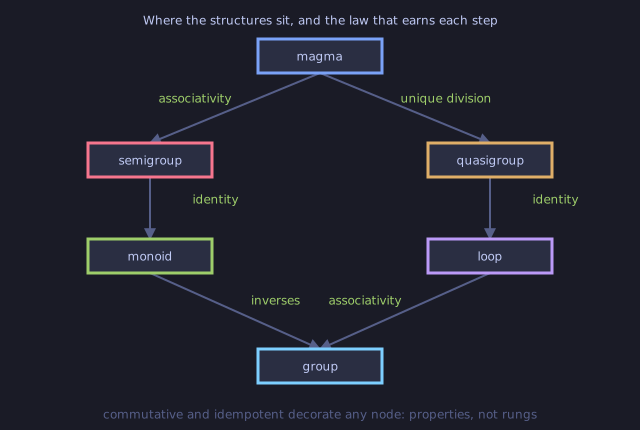 Where you are heading, and the law that earns each step. Two different
routes reach a group. This diagram is checked, not drawn — every
box holds a real grid, and a program verifies each one lands where the
picture claims.
Where you are heading, and the law that earns each step. Two different
routes reach a group. This diagram is checked, not drawn — every
box holds a real grid, and a program verifies each one lands where the
picture claims.
UNDER THE HOOD
LIVE
Runtime check — the machinery, if you are curious
Not a lesson. It proves the real sw-MLPL interpreter runs inside this page,
loads the same algebra library the command-line tests use, and grades
submitted answers. Ten checks; watch them pass.